


How to Tell if Native American Jewelry Is Authentic
Authentic Native American jewelry is not hard to recognize once you know what to look for. The difficulty is that the market around it has developed very good ways of looking similar without being the same thing. This guide covers what genuine pieces actually share, what the law does and does not protect, and how to read a piece before you buy it.

What Authentic Native American Jewelry Actually Looks Like
Genuine pieces share a few physical qualities that are hard to fake at scale.
The silver has weight. Navajo silversmithing traditionally starts with heavy-gauge metal, hand-hammered or hand-formed rather than machine-cast. Pick up an authentic ingot cuff and it is immediately different from the featherweight reproductions that share shelf space with it in gift shops. The heft is one of the fastest tells.
The work is irregular in the right ways. Hand-stamped silver shows the rhythm of someone working by hand. The repeating geometric patterns in stampwork have slight variations from impression to impression. Stones in needlepoint settings, where the silversmith cuts tiny pointed ovals and sets them in tight clusters, are individually fitted rather than dropped into machine-punched holes. Inlay work fits stone to stone with visible craft decisions at every joint. Perfect uniformity across a piece is a sign of machine production.
The stone is usually turquoise, coral, spiny oyster shell, black jet, or lapis. Natural turquoise varies in color and matrix. It does not look like plastic. Stabilized turquoise, which has been treated with resin to harden it, is more uniform and more durable but is worth less and should not be sold as natural. Synthetic turquoise is neither.
There is usually a mark on the back. Older pieces are the exception, and that does not make them fakes.


What the Indian Arts and Crafts Act Actually Covers
The Indian Arts and Crafts Act of 1990 makes it a federal crime to misrepresent a product as Indian-made when it is not. The law covers both the claim of being Indian-produced generally and the claim of being produced by a specific tribe. Penalties run up to $250,000 and five years for an individual on a first offense. Businesses face fines up to $1 million.
That is the law. Here is the gap.
"Native American style" is legal. "Southwest inspired" is legal. "In the tradition of" is legal. These phrases do a lot of work on gift-shop shelves and online product listings, sitting in the same visual space as genuinely handmade work from actual Navajo and Zuni silversmiths. A buyer reading quickly may not catch the distinction. The seller almost certainly knows it is there.
The GAO looked at the scale of this problem in 2011 and found that the extent of misrepresentation is unknown. Every figure that circulates in this market traces back to a 1985 Commerce Department study built largely on expert estimates. There is no national database and no reliable count. So a buyer cannot look up how worried to be. They can only look at the piece in front of them and the person selling it.

Red Flags Worth Knowing
A price that seems low for hand-forged silver and natural stone is the first flag. Genuine materials and genuine labor have a floor. A piece that costs what a factory piece costs is probably a factory piece.
No hallmark on a contemporary piece is a serious problem. Silversmiths working today mark their work. If a new piece has nothing on the back, either no one is claiming it or the mark was taken off. Older jewelry is the exception to this, and it is a large exception. Read the next two sections before you rule out an unmarked piece.
Language like "Native American style," "handcrafted in the Southwest," or "inspired by traditional designs" means the seller is not claiming the piece is Indian-made. They wrote it that way deliberately.
A vendor who cannot tell you the artist's name, tribe, or home community is a vendor who does not know. At a legitimate trading post or gallery with direct artist relationships, someone should be able to answer those questions, because those relationships are the whole point.
Machine-perfect uniformity in stampwork or stone settings. Turquoise that looks too consistent in color. Settings that look identical across fifty pieces in a display case. These are manufacturing signatures, not craft signatures.

How to Read a Hallmark
A hallmark is a mark the silversmith strikes into the metal of the finished piece, usually on the back of a cuff, the inside of a ring shank, or the back of a pendant. It identifies the maker.
Marks vary widely. Some silversmiths use their initials. Some use a symbol, an animal, or a design element specific to their family. Some marks are registered; others are family marks passed down across generations. A known mark from a known smith in a documented collection carries different weight than a mark no one at the gallery can identify.
A hallmark names the maker. It does not tell you where the silver came from, what mine the turquoise came out of, or whether the materials were sourced before or after the piece was commissioned. That is useful information the hallmark alone cannot give you, which is why provenance at the point of sale matters.
Reading a hallmark is a skill that builds over time. The more pieces you handle from identified artists with documented work, the more the marks start to have context. The best galleries and trading posts explain the marks on request, because they bought the work directly and know the story behind it.

An Unmarked Piece Is Not Automatically a Fake
Hallmarks are a recent habit. Before the 1930s, most Navajo silver was not marked at all. The practice spread slowly through the middle of the century, and it did not become standard until the 1970s. A silversmith in 1925 was making jewelry to wear and to trade, not to sign.
So a genuine old piece often has a bare back. It is still handmade. It is still Navajo, Zuni, or Hopi. It is still silver worked by hand at a bench. What is missing is the name. Nobody can tell you who made it, because nobody wrote it down at the time.
Much of what the trade calls old pawn falls into this category. Those pieces get judged on the work itself: the gauge of the silver, the tooling, the stones, the wear on the back from decades of being worn. An experienced buyer can usually place an unmarked piece by era, and often by region, without any mark to go on. A good trading post will tell you plainly what it can and cannot say about where a piece came from.
The flag is about age, not honesty. An unmarked piece made last year is a question worth asking. An unmarked piece made in 1930 is a piece of history whose maker's name did not survive.

Why Where You Buy Matters
Gallup, New Mexico is the center of the Native American jewelry trade. The Navajo, Zuni, and Hopi silversmiths who produce the most sought-after work in the Southwest live and work in and around this city. The pieces move outward from here.
They move to Santa Fe. They move to Sedona. They move to the galleries on streets where real estate is expensive and overhead is high, and they are priced to reflect all of that. Buyers who travel to those cities are often paying a large multiple over what the same piece, by the same artist, costs at the source. Sometimes the artist whose name is on the tag sells the same work directly in Gallup.
This is not an argument against Santa Fe or Sedona. It is an argument for understanding what you are paying for. Proximity to the source means the people selling you the piece are closer to the people who made it, which means they usually know more about it.
Richardson's Trading Post has been on Route 66 in Gallup since 1913. Every piece in the store is bought directly from the artist. No wholesalers, no middlemen, no pieces that arrived in a crate with no attribution. When you ask about a piece, the answer to "who made this" is a name, not a shrug.
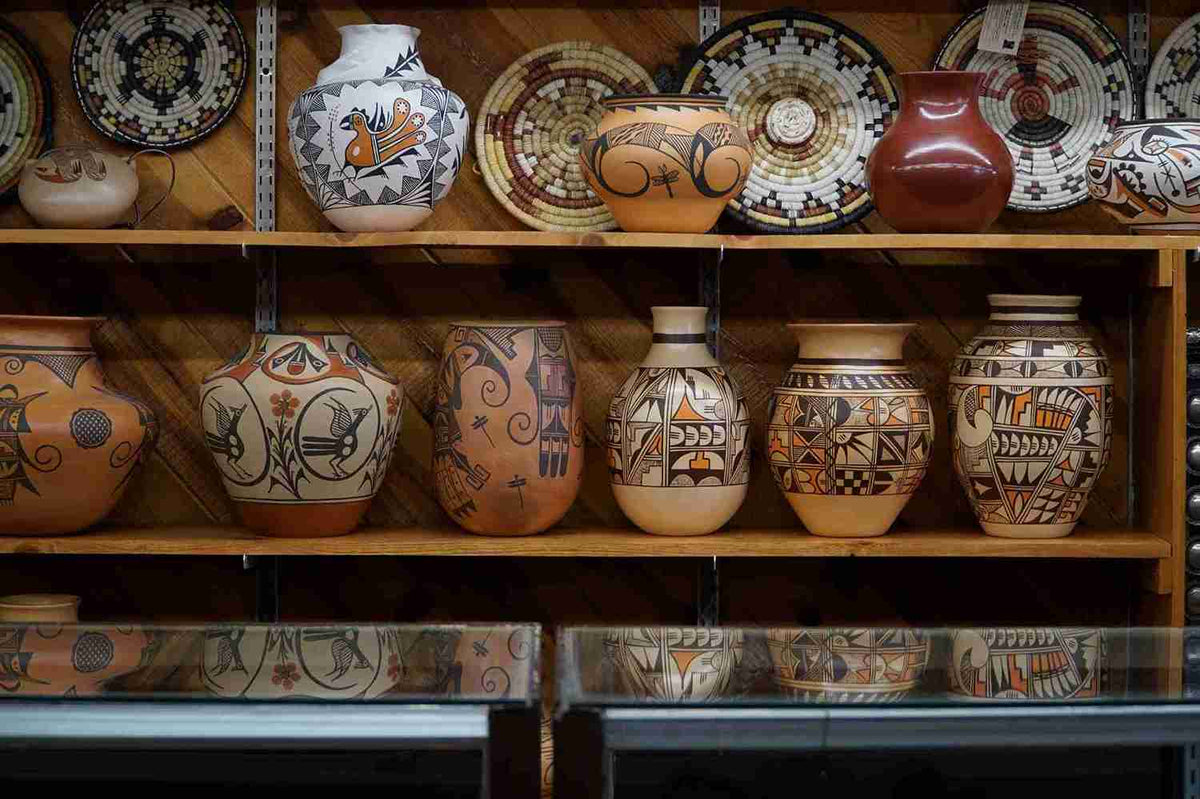
Richardson's Trading Post
This store has bought directly from Navajo, Zuni, and Hopi artists for 113 years. The relationships are generational. Some of the silversmiths whose work is in the cases today are the grandchildren of silversmiths who sold to the same family.
The Richardson stamp, recently introduced, takes that one step further. On stamped pieces, Richardson's bought the silver and the stones before the work began, supplied them to the silversmith, and received finished jewelry in return. Both the silversmith's hallmark and the Richardson mark appear on the back. The materials are natural turquoise from American mines, most often Bisbee, Kingman, and Royston.
If you want to understand a piece before you buy it, the store is at 223 W Historic Hwy 66 in Gallup. Call 505-722-4762. Browse the collection online. The same questions get the same answers either way.
Frequently Asked Questions
How can I tell if Native American jewelry is real?
Look for a hallmark on the back of the piece, ask who made it and where they are from, and check whether the seller can answer those questions without hesitation. Hand-forged silver has weight and slight irregularities that machine-made pieces do not. Natural stone varies in color and matrix in ways synthetic and stabilized materials do not. On older pieces, expect no hallmark at all and judge the work instead.
Is Native American jewelry without a hallmark fake?
Not necessarily, and this trips up a lot of buyers. Most Navajo silver made before the 1930s carries no mark, and hallmarking did not become standard practice until the 1970s. An older piece with a bare back can be completely genuine. What it cannot do is tell you who made it, because the smith never signed it. On a piece made recently, a missing mark is a real concern.
Is it illegal to sell fake Native American jewelry?
Selling something as Indian-made when it is not is a federal crime under the Indian Arts and Crafts Act of 1990. Penalties reach $250,000 and five years for an individual. The gap in the law is that "Native American style" and "Southwest inspired" are not illegal claims, even when placed next to genuinely deceptive products.
What is a hallmark on Native American jewelry?
A mark the silversmith strikes into the finished silver. It identifies the maker and may take the form of initials, a personal symbol, or a family mark. A hallmark names the person who made the piece but does not by itself document where the materials came from. Hallmarks are also a modern practice, so most early pieces do not have one.
What is the difference between natural and stabilized turquoise?
Natural turquoise is untreated stone as it came from the mine. Stabilized turquoise has been treated with resin to harden it and make it more uniform in color. Both are real turquoise. Natural commands a higher price and should be identified as natural when sold. Synthetic turquoise is neither.
Why is Gallup considered the center of Native American jewelry?
The Navajo, Zuni, and Hopi silversmiths who produce the most significant work in the Southwest live and work in and around Gallup. The jewelry originates here and moves outward to galleries in Santa Fe, Sedona, and beyond, often at significantly higher prices. Gallup is where the trade is at its source.
What should I ask before buying a piece?
Who made it, what tribe they belong to, where they are based, what the stone is and whether it is natural, and where the silver came from. If the piece is old and unmarked, ask what the seller can tell you about its era and where it came into the store. A seller with direct artist relationships should be able to answer all of these. If they cannot, that is information too.